SUPEREGO
Conscience, norms, imagos - shaped by parents and environment. Partly conscious, partly unconscious.
The psychodynamic model forms the foundation for understanding mental disorders. It explains how the different agencies of the psyche interact - and what happens when this interplay is disrupted.
SUPEREGO
Conscience, norms, imagos - shaped by parents and environment. Partly conscious, partly unconscious.
EGO
The personality itself. Partly conscious, partly unconscious.
ID
The drives and impulses of a person. Entirely unconscious.
Humans possess three basic drives:
| Drive | Function |
|---|---|
| Hunger | Food intake |
| Thirst | Fluid intake |
| Sleep | Regeneration |
Impulses are those forces that drive us to do something specific:
Self-preservation instinct
The fundamental drive for survival
Sexual drive
Reproduction and sexuality
Nurturing instinct
Care for offspring
Power drive
Striving for influence and control
Desire for dominance
Striving for supremacy
Greed
Striving for possessions
The EGO has three main tasks:
What happens when this chance is missing?
If the EGO does not get the chance to develop, only fragments (broken pieces) can form, which are disconnected and do not create a complex unit.
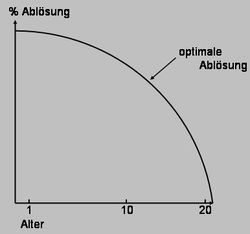
Imagine (for a healthy person) a complete, whole spirit level that is perfectly balanced:
The Self encompasses:
This complex is compared with a pillar of the SUPEREGO: the ego ideal and ideal self. The difference is called the ego discrepancy.
Over time, humans develop defense mechanisms that protect the EGO. They sit between the ID and the SUPEREGO as a buffer zone. Without them, the EGO would be literally torn apart.
1. Splitting Early stage of defense mechanisms (baby to 4 years). Can only divide into good and bad. Applied as long as no complete EGO is available.
2. Projection Transferring disapproval of one’s own inadequacies or immoral desires onto other people.
3. Regression Retreat to an earlier developmental stage with primitive reactions and a low level of aspiration.
4. Compensation Concealing a weakness by overemphasizing a character trait. Frustration in one area is compensated by excessive gratification in another.
5. Denial Protection from unpleasant reality by refusing to accept it.
6. Displacement Discharging accumulated hostile feelings onto objects that are less dangerous than the original triggers.
7. Emotional isolation Avoiding traumatic experiences by retreating into passivity.
8. Fantasy Satisfying frustrated desires through imaginary fulfillment (e.g., daydreams).
9. Identification Increasing self-esteem through identification with another person or institution.
10. Introjection Incorporating external values into the EGO structure so that the person no longer has to experience them as an external threat.
11. Isolation Separating emotional reactions from anxiety-laden situations.
12. Rationalization Attempting to convince oneself that one’s behavior is rationally justified.
13. Reaction formation Avoiding anxiety-laden situations by overemphasizing opposite behaviors.
14. Repression Preventing unwanted impulses from entering consciousness.
15. Sublimation Satisfying unfulfilled desires through socially acceptable substitute actions.
16. Undoing Seeking atonement for immoral desires and actions.
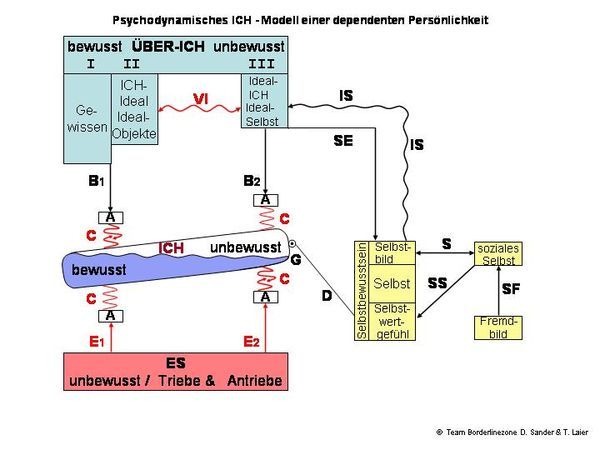
The EGO, together with its defense mechanisms, contains EGO strength - the degree to which the EGO has the drives (ID) under control.
EGO strength refers to:
The self-image contains the cognitions and feelings one has about oneself. It arises from:
Definition
The ego discrepancy is the difference between self-image and ideal self. The greater the ego discrepancy, the lower the self-esteem.
The striving to reduce the ego discrepancy means self-actualization.
The smaller the ego discrepancy, but the more pathological (overvalued, unrealistic) the ego ideal:
Self-esteem is a disposition of the Self through which a person experiences themselves as a bearer of value. Its negation is the sense of inferiority.
The ID lies in the unconscious and contains the drives and impulses. These are enormous energies that make us do what we do (want to) or should.
Pleasure Principle
The ID strives for the immediate and complete discharge of its drive energies - very clearly visible in borderline personality disorder through its immediate drive gratification.

The SUPEREGO consists of three pillars:
The SUPEREGO has assumed the function of a judge and guardian:
The internalized objects (internalized parental images) are significantly involved in the development of the SUPEREGO:
ID: Pleasure Principle
Strives for the immediate and complete discharge of drive energies and maximum pleasure.
EGO: Reality Principle
Transforms the drive impulses originating from the ID into ethical and social demands.
SUPEREGO: Morality Principle
Acts according to moral and ethical norms (commandments and prohibitions).
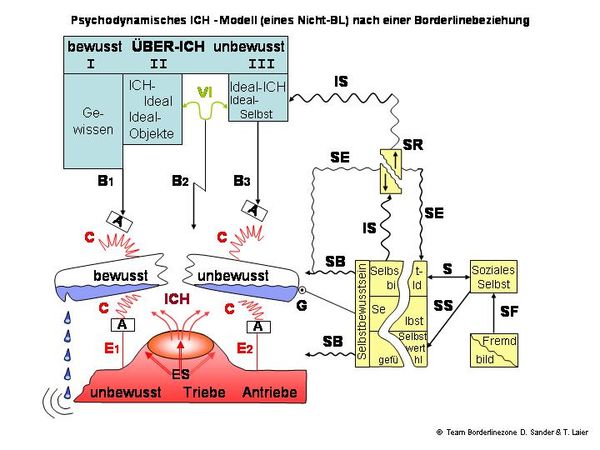
In borderline personality disorder: