Neurobiology and the Brain
The human brain is the control center for all physical and psychological processes. A basic knowledge of brain structures and biochemical processes is helpful for understanding mental disorders such as borderline personality disorder.
The Human Brain - Structure and Components
Section titled “The Human Brain - Structure and Components”Cortex (Neocortex)
Section titled “Cortex (Neocortex)”The cerebrum is the seat of logic, reason, motor association areas and projection fields. It is the center of all sensory perceptions.
Hypothalamus
Section titled “Hypothalamus”Part of the limbic system, which consists of the hypothalamus, thalamus, hippocampus and amygdala - the seat of feelings and emotions. The hypothalamus is part of the diencephalon and the highest center of the autonomic (vegetative) nervous system.
Here the coordination and integration of all vegetative body functions and the hormone balance takes place:
- Carbohydrate metabolism
- Water and salt balance
- Thermal equilibrium
- Sexual functions
- Motivational reinforcement (hunger, sexuality)
Heart rate and respiration are also indirectly influenced via the nuclei of the medulla.
Pituitary Gland (Hypophysis)
Section titled “Pituitary Gland (Hypophysis)”The pituitary gland is approximately bean-sized and an endogenous gland. It is directly connected to the hypothalamus and forms a functional unit - the central interface between neural and hormonal regulatory processes.
Important hormones of the pituitary gland:
| Anterior Lobe | Posterior Lobe |
|---|---|
| Growth hormone (STH) | Oxytocin |
| Follicle-stimulating hormone (FSH) | Vasopressin |
| Luteinizing hormone (LH) | |
| Prolactin (HPr) | |
| Thyrotropin (TSH) | |
| Adrenocorticotropin (ACTH) |
Thalamus
Section titled “Thalamus”Part of the limbic system. The thalamus comes from the Greek and means “chamber, cavity.” It is the dorsal nuclear region of the diencephalon. All sensory pathways converge here, where they are emotionally colored before becoming conscious experience (anger, warmth, etc.) in the cerebrum.
The electrical activity of the cerebrum and thus the attention and wakefulness functions are controlled by the thalamus.
Prefrontal Cortex
Section titled “Prefrontal Cortex”The prefrontal cortex contains the frontal lobe, which is divided into left and right. Responsible for:
- Cognitive activities such as planning
- Decision-making
- Goal-setting
- Connecting present and future through planful action
It communicates closely with the limbic system via the dopamine pathways. Damage to the prefrontal cortex can have devastating psychological effects.
Hippocampus
Section titled “Hippocampus”Parts of the hippocampus also belong to the limbic system. It plays a central role in memory consolidation - specifically for:
- Encoding and transferring information from short-term to long-term memory
- Retaining spatial orientations
Amygdala (Almond-Shaped Body)
Section titled “Amygdala (Almond-Shaped Body)”The amygdala is the decisive guardian in controlling emotions and has a decisive influence on emotional memory.
The Limbic System - Seat of Emotions
Section titled “The Limbic System - Seat of Emotions”The limbic system is the central structure for our emotions. It consists of:
- Hypothalamus
- Thalamus
- Hippocampus
- Amygdala
- Nucleus accumbens
The Reward System
Section titled “The Reward System”In 1954, the American neuroscientists James Olds and Peter Milner discovered the reward system in the brain. In experiments with rats, they showed that the animals pressed a lever to administer electrical stimulation to the reward system - even accepting painful electric shocks to do so.
The reward system essentially consists of three elements:
- Nucleus accumbens - part of the limbic system
- Ventral tegmental area in the midbrain
- Prefrontal regions of the cerebral cortex
Neurotransmitters and Addiction Development
Section titled “Neurotransmitters and Addiction Development”The dopamine system receives support from other messenger substances:
- Endogenous opioids (endorphins)
- Cannabinoids (anandamides)
Both opiate drugs and endogenous opioids bind to opiate receptors in the nucleus accumbens. Studies on bungee jumpers showed a 200-fold increase in beta-endorphins during and immediately after the jump.
Addictive substances such as cocaine, amphetamines, or heroin release increased amounts of dopamine in the reward system.
Neural Networks
Section titled “Neural Networks”How Memories Work
Section titled “How Memories Work”A specific face corresponds in the brain to a very specific combination of many nerve cells - a network structure that fires together in response to a signal (trigger). This can be triggered by someone who walks, smells, or looks similar, without it needing to be consciously perceived.
Structure of a Nerve Cell
Section titled “Structure of a Nerve Cell”A biological nerve cell consists of:
| Component | Function |
|---|---|
| Soma | Cell body |
| Dendrites | Short conductors (approx. 0.4 mm), through which stimuli enter the nerve cell |
| Axon | Conductor for transmitting cell activity to other cells (mm to several meters) |
| Synapses | Contact points between axons and dendrites |
When the soma is stimulated beyond a certain threshold, the cell generates a brief electrical impulse (spike), which is transmitted by the axon to other cells.
Synapses and Neurotransmitters
Section titled “Synapses and Neurotransmitters”Synapses are chemical contacts that respond to a spike by releasing certain ions (neurotransmitters):
- Acetylcholine
- Serotonin
- Dopamine
- Adrenaline
- Noradrenaline
These are released from synaptic vesicles into the synaptic cleft and taken up by the subsequent neuron. They dock at corresponding receptors and in turn trigger electrical activity.
Biochemistry and Stress Response
Section titled “Biochemistry and Stress Response”The Three Happiness Messengers
Section titled “The Three Happiness Messengers”Three substances are primarily responsible for your well-being:
- Serotonin
- Dopamine
- Noradrenaline
During stress, the two main substances adrenaline and cortisol are released, with cortisol having a regulatory function on adrenaline.
The Stress Axis (HPA Axis)
Section titled “The Stress Axis (HPA Axis)”In danger, the thalamus activates the amygdala (emotional guardian). This activates CRH (Corticotropin-Releasing Hormone) via the hypothalamus:
HPA Axis: Hypothalamus (CRH) → Pituitary (ACTH) → Adrenal glands (Glucocorticoids/Cortisol)
Effects of Chronic Stress
Section titled “Effects of Chronic Stress”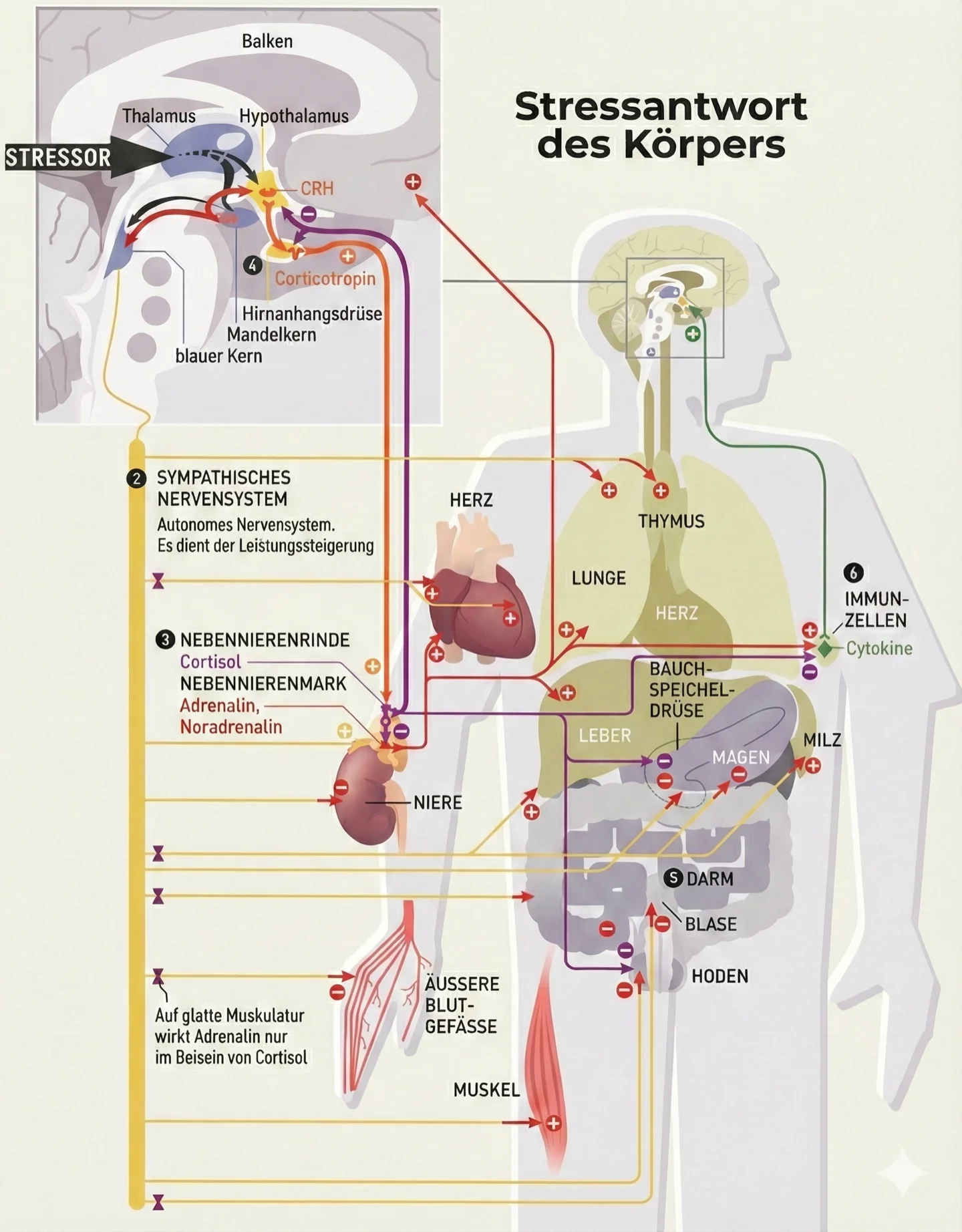
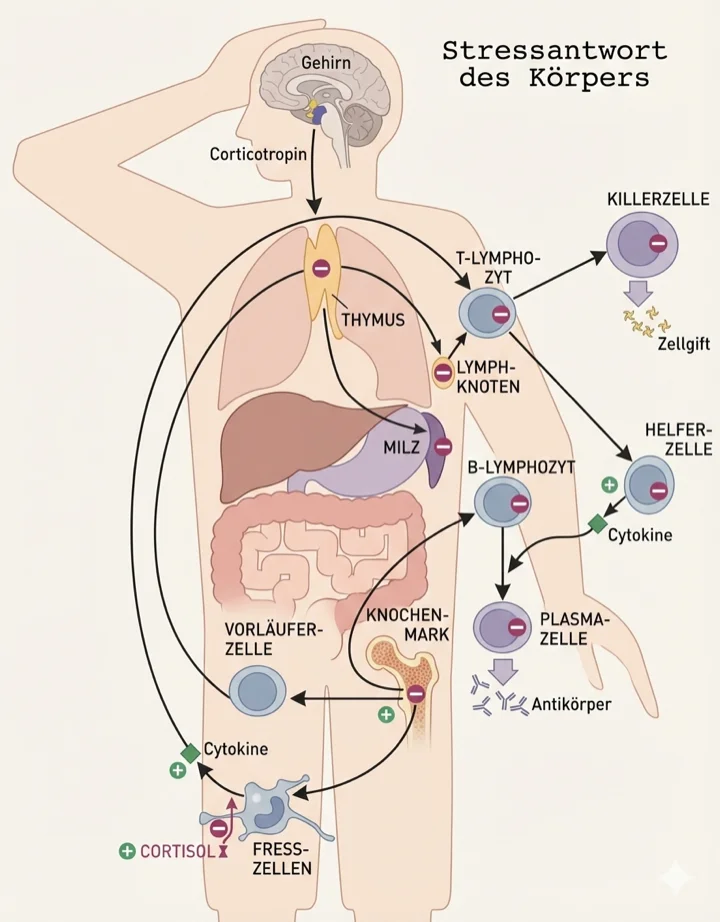
During prolonged dis-stress, the following are activated:
- Adrenaline, noradrenaline
- Rise in blood sugar levels
- Cortisol
- Increase in blood pressure
- Activation of the sympathetic nervous system
- Increase in thyroid function
- Immune system with phagocytes
Consequences of Chronic Dis-Stress on the Body
Section titled “Consequences of Chronic Dis-Stress on the Body”| Organ | Effect |
|---|---|
| Brain | Certain cytokines destroy nerve cells. Elevated cortisol damages the hippocampus |
| Pancreas | Cortisol reduces insulin effectiveness, can lead to diabetes |
| Stomach | Noradrenaline constricts blood vessels of digestive organs (ulcers, inflammation) |
| Muscles | Increasingly consume muscle protein, muscles shrink |
| Blood vessels | Chronically elevated blood pressure damages vessels (arteriosclerosis, heart attacks) |
| Reproductive organs | Cortisol inhibits hormone synthesis (impotence, menstrual disorders) |
Nutrition for the Brain
Section titled “Nutrition for the Brain”Important Nutrients
Section titled “Important Nutrients”The raw material for positive feelings are three amino acids:
- Phenylalanine - precursor of tyrosine, dopamine, noradrenaline
- Tyrosine - converted into dopamine
- Methionine - involved in conversion to noradrenaline
Recommendations During Stress
Section titled “Recommendations During Stress”To avoid:
- Pasta, polished rice, pizza
- Sugar and sweet drinks
- Alcohol
- Potatoes
To prefer:
- Complex carbohydrates during the day (whole grain products, fruit, vegetables)
- Protein with vitamin C in the evening
- B vitamins (especially in brewer’s yeast)
- Magnesium, zinc, manganese, calcium