Psychodynamic Model of Depression
The psychodynamic model helps to understand how the various psychic agencies (ego, superego, id) interact in depression and which inner conflicts contribute to the illness.
The Ego Model in Depression
Section titled “The Ego Model in Depression”The following diagram shows the interplay of the psychic agencies in depressive illness.
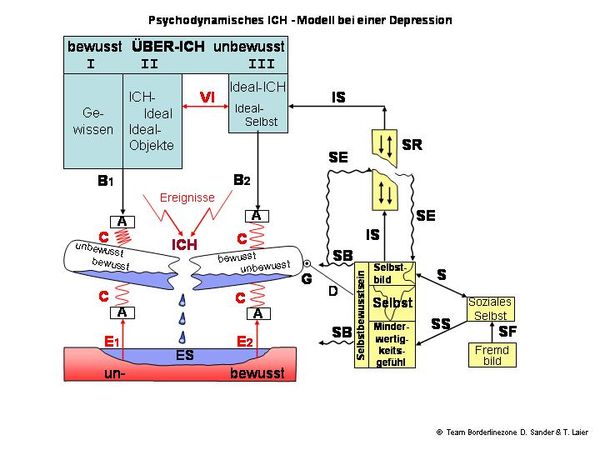
Key to the Ego Model
Section titled “Key to the Ego Model”| Symbol | Meaning |
|---|---|
| A | Defence mechanisms of the ego |
| B1 | Forces or energies pressing on the ego from Pillars I and II of the superego |
| B2 | Forces or energies pressing on the ego from Pillar III of the superego |
| C | Defence energies that the ego draws upon for its defence mechanisms |
| A+C | Defence action of the ego |
| D | Rigid connection with inversive joint (G) to the self |
| E1, E2 | Id impulses, drive energies |
| G | Inversive joint (inversive = reversal) |
| SB | Self-observation, introspection |
| S | Comparison of social self with self and vice versa |
| SE | Self-awareness |
| SF | Transition of external image into the social self |
| SR | Self-regulatory mechanisms |
| SS | Influence of the social self on self-esteem |
| IS | Ego discrepancy, self-actualisation, narcissistic balance |
| VI | Comparison ideal ego / ideal self versus ego ideal / ideal objects |
The Superego in Depression
Section titled “The Superego in Depression”The superego plays a central role in depression. It contains internalised norms, values, and prohibitions that are often excessively strict.
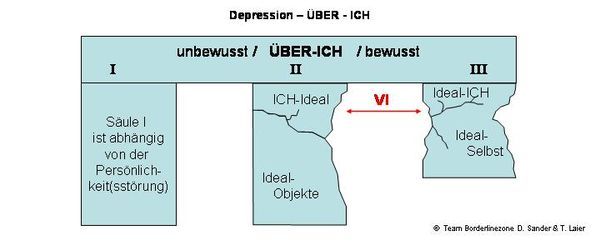
Psychodynamic Explanation of Depression
Section titled “Psychodynamic Explanation of Depression”The Depressive Core Conflict
Section titled “The Depressive Core Conflict”Analysts speak of the depressive core conflict in depression:
The Self-Worth Conflict
Section titled “The Self-Worth Conflict”At the same time, the self-worth conflict is present in depressive individuals:
“Excessive demands on oneself and simultaneously complete self-devaluation.”
These conflicts also apply to Borderline Personality Disorder and form, among other things, its core conflict as well. This shows how closely depression belongs to Borderline Personality Disorder.
Origins in Childhood
Section titled “Origins in Childhood”The rejection and devaluation that the child experiences from their parents — particularly the mother — inevitably leads to the question:
“What is wrong with me that I am not loved?”
This question becomes so deeply internalised that it forms the basis of the adult’s later self-doubt. This also explains the frequently occurring depressive episodes in Borderline Personality Disorder.
The Role of the Psychic Agencies
Section titled “The Role of the Psychic Agencies”The Id
Section titled “The Id”The id contains the drives and impulses. In depression, these are often:
- Suppressed by an overpowering superego
- Directed against the self (auto-aggression)
- Turned inward in the form of rage
The Ego
Section titled “The Ego”The ego in depression is:
- Weakened and overburdened
- Unable to mediate between id and superego
- Equipped with rigid defence mechanisms
The Superego
Section titled “The Superego”The superego in depressive individuals is often:
- Excessively strict and punishing
- A source of constant self-criticism
- Unrealistic in its demands
Therapeutic Implications
Section titled “Therapeutic Implications”Understanding these psychodynamic connections is important for therapy:
- Making conscious the inner conflicts
- Loosening the overly strict superego
- Strengthening the ego
- Integration of split-off feelings (especially rage)
- Working through early relationship experiences